


Leading Off-Gas Detection. Higher BESS Standards.
The stationary Li-ion BESS market is growing fast. So is awareness of the inherent fire risks of Li-ion batteries — specifically the dangers of thermal runaway.
With the advent of "off-gas” detection, regulators, industry bodies, and insurers now recognize the vital role of early warning systems in preventing catastrophic failures.
As a result, existing fire safety standards are being updated and new codes are emerging—all focused on building a safer, more resilient energy storage infrastructure.
Li-ion Tamer® helps you stay ahead of these changes—supporting compliance, reducing risk, and protecting uptime.
THE KEY TO FIRE SAFETY COMPLIANCE IN BESS APPLICATIONS
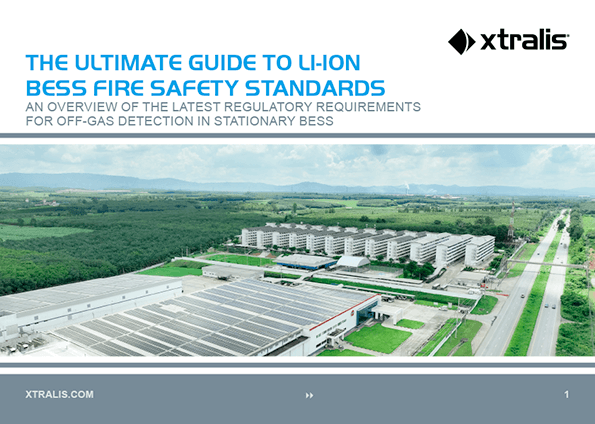 From the NFPA to FM Global, leading national and international bodies are raising the bar in Li-ion BESS fire safety. Several major standards have been revised while new guidelines and requirements have been introduced to ensure more effective prevention against thermal runaway. The Ultimate Guide to Li-ion BESS Fire Safety Standards helps BESS operators, OEMs, and system integrators navigate the latest regulatory changes, covering:
- The latest installation standards revisions addressing BESS safety
- Revisions of product standards that support the new BESS safety requirements
- New installation and product requirements set by the insurance industry
- The most recent European guidelines
- Examples of building codes requiring off-gas detection
- And more
GET THE GUIDE
Download the Ultimate Guide to BESS Fire Safety Standards.
FIRE STANDARDS AT A GLANCE
Learn how with the new fire standards Li-ion Tamer protects every area of your application.
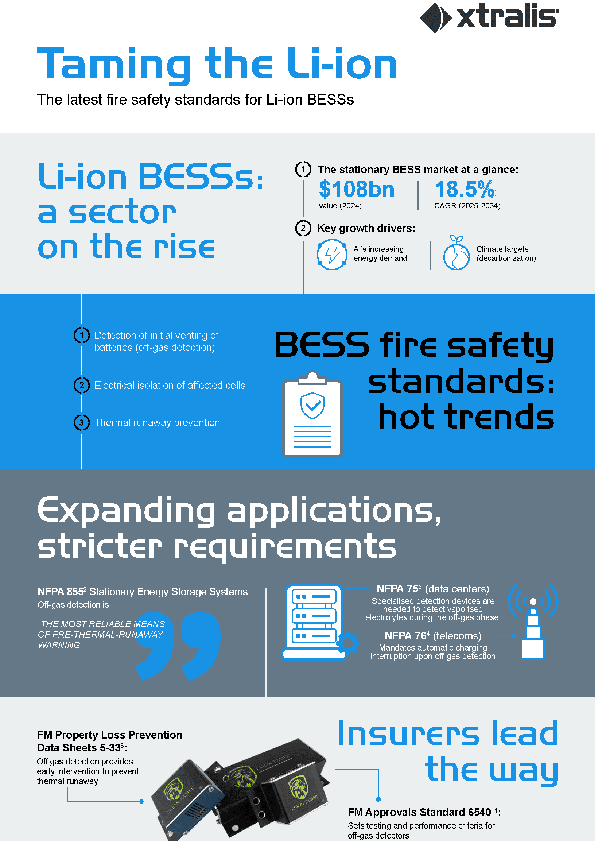 BESS FIRE SAFETY STANDARDS AT A GLANCE
Fire safety standards are changing across the Li-ion BESS sector. This infographic gives you a quick, clear snapshot of today’s off-gas detection requirements and guidelines.
GLOBAL LI-ION BESS FAILURES
Li-ion batteries can and do cause destructive fires without proper safety measures or advanced electrolyte vapor detection technologies like Li-ion Tamer. The Electric Power Research Institute (EPRI's) BESS Failure Event Database has documented where these fires have happened globally.View the Database

UNLOCK SAFER, MORE EFFICIENT POWER
Discover what happens inside a Li-ion BESS during thermal runaway and find out how an early warning can help to prevent a disaster.

XTRALIS' LI-ION TAMER GEN 3: A BETTER, SAFER WAY OF BESS FIRE DETECTION
THE KEY TO FIRE SAFETY COMPLIANCE IN BESS APPLICATIONS
From the NFPA to FM Global, leading national and international bodies are raising the bar in Li-ion BESS fire safety. Several major standards have been revised while new guidelines and requirements have been introduced to ensure more effective prevention against thermal runaway. The Ultimate Guide to Li-ion BESS Fire Safety Standards helps BESS operators, OEMs, and system integrators navigate the latest regulatory changes, covering:
- The latest installation standards revisions addressing BESS safety
- Revisions of product standards that support the new BESS safety requirements
- New installation and product requirements set by the insurance industry
- The most recent European guidelines
- Examples of building codes requiring off-gas detection
- And more
GET THE GUIDE
Download the Ultimate Guide to BESS Fire Safety Standards.
FIRE STANDARDS AT A GLANCE
Learn how with the new fire standards Li-ion Tamer protects every area of your application.
BESS FIRE SAFETY STANDARDS AT A GLANCE
Fire safety standards are changing across the Li-ion BESS sector. This infographic gives you a quick, clear snapshot of today’s off-gas detection requirements and guidelines.
GLOBAL LI-ION BESS FAILURES
Li-ion batteries can and do cause destructive fires without proper safety measures or advanced electrolyte vapor detection technologies like Li-ion Tamer. The Electric Power Research Institute (EPRI's) BESS Failure Event Database has documented where these fires have happened globally.View the Database
UNLOCK SAFER, MORE EFFICIENT POWER
Discover what happens inside a Li-ion BESS during thermal runaway and find out how an early warning can help to prevent a disaster.
XTRALIS' LI-ION TAMER GEN 3: A BETTER, SAFER WAY OF BESS FIRE DETECTION
Managing the potential fire risk associated with BESSs is vital for creating safer and reliable operations. The optimum method to effectively address this is electrolyte vapor detection.
ELIMINATE RISKS WITH EARLY WARNING
 The complex design of Li-ion BESSs presents numerous challenges to effective fire detection and suppression. The latest electrolyte solvent vapor detection can help resolve them, optimizing safety and uptime. The Li-ion Tamer® Design Guide outlines how to optimize detection tailored to individual BESS rack designs, layouts and ventilation configurations.
The Guide will help you understand:
- Key standards and regulations related to BESS fire safety
- What you need to consider to optimize electrolyte solvent vapor detection
- Common issues experienced when installing the detectors
GET THE GUIDE
Download the Xtralis Li-ion Tamer Design Guide.

KEY STEPS TO OPTIMIZING EARLY DETECTION IN BESS
From external air entry points to battery rack designs, many elements can potentially compromise electrolyte vapor detection and put a BESS at risk. Learn the main issues and discover simple steps to manage them.
LI-ION TAMER SENSOR MOS APPLICATION IN BESS CONTAINER CASE STUDY
Designed as a dual-capable sensor to provide very early warning of lithium-ion battery failures, before the onset of thermal runaway, and explosion prevention in accordance with standards such as NFPA 855 and NFPA 69. Learn how the Li-ion Tamer Sensor Multi Output Solution (MOS) was chosen to protect the containers for a global Chinese BESS manufacturer.
LI-ION TAMER SENSOR MOS APPLICATION IN BESS MODULAR CUBES CASE STUDY
Lithium-ion batteries are inherently fragile and are prone to failure which can lead to damaging fires. Read how the Li-ion Tamer Sensor MOS was selected for installation in lithium-ion battery modular cubes for a global Chinese BESS manufacturer.
ELIMINATE RISKS WITH EARLY WARNING
The complex design of Li-ion BESSs presents numerous challenges to effective fire detection and suppression. The latest electrolyte solvent vapor detection can help resolve them, optimizing safety and uptime. The Li-ion Tamer® Design Guide outlines how to optimize detection tailored to individual BESS rack designs, layouts and ventilation configurations.
The Guide will help you understand:
- Key standards and regulations related to BESS fire safety
- What you need to consider to optimize electrolyte solvent vapor detection
- Common issues experienced when installing the detectors
GET THE GUIDE
Download the Xtralis Li-ion Tamer Design Guide.
KEY STEPS TO OPTIMIZING EARLY DETECTION IN BESS
From external air entry points to battery rack designs, many elements can potentially compromise electrolyte vapor detection and put a BESS at risk. Learn the main issues and discover simple steps to manage them.
LI-ION TAMER SENSOR MOS APPLICATION IN BESS CONTAINER CASE STUDY
Designed as a dual-capable sensor to provide very early warning of lithium-ion battery failures, before the onset of thermal runaway, and explosion prevention in accordance with standards such as NFPA 855 and NFPA 69. Learn how the Li-ion Tamer Sensor Multi Output Solution (MOS) was chosen to protect the containers for a global Chinese BESS manufacturer.
LI-ION TAMER SENSOR MOS APPLICATION IN BESS MODULAR CUBES CASE STUDY
Lithium-ion batteries are inherently fragile and are prone to failure which can lead to damaging fires. Read how the Li-ion Tamer Sensor MOS was selected for installation in lithium-ion battery modular cubes for a global Chinese BESS manufacturer.
Li-ion Tamer helps you protect people, property and your brand from the risks associated with thermal runaway, allowing ongoing reliable power supply.
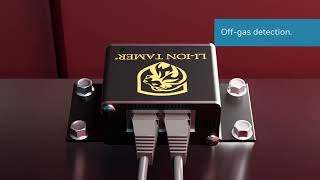
SEE LI-ION TAMER IN ACTION
Check out how Li-ion Tamer electrolyte vapor detection helps protect a typical containerized BESS against the catastrophic effects of thermal runaway.
CHOOSE TO MAKE GREEN POWER, SAFE POWER
The Li-ion Tamer GEN 3 system provides the earliest possible warning of thermal runaway, enabling users to reduce the risk and create safer and more efficient operations.
The Li-ion Tamer Sensor MOS is a device that detects hydrogen and carbon monoxide gases, which are generated during thermal runaway of lithium-ion batteries.
SEE LI-ION TAMER IN ACTION
Check out how Li-ion Tamer electrolyte vapor detection helps protect a typical containerized BESS against the catastrophic effects of thermal runaway.
CHOOSE TO MAKE GREEN POWER, SAFE POWER
The Li-ion Tamer GEN 3 system provides the earliest possible warning of thermal runaway, enabling users to reduce the risk and create safer and more efficient operations.
The Li-ion Tamer Sensor MOS is a device that detects hydrogen and carbon monoxide gases, which are generated during thermal runaway of lithium-ion batteries.
THE KEY TO FIRE SAFETY COMPLIANCE IN BESS APPLICATIONS
From the NFPA to FM Global, leading national and international bodies are raising the bar in Li-ion BESS fire safety. Several major standards have been revised while new guidelines and requirements have been introduced to ensure more effective prevention against thermal runaway. The Ultimate Guide to Li-ion BESS Fire Safety Standards helps BESS operators, OEMs, and system integrators navigate the latest regulatory changes, covering:
- The latest installation standards revisions addressing BESS safety
- Revisions of product standards that support the new BESS safety requirements
- New installation and product requirements set by the insurance industry
- The most recent European guidelines
- Examples of building codes requiring off-gas detection
- And more
GET THE GUIDE
Download the Ultimate Guide to BESS Fire Safety Standards.
FIRE STANDARDS AT A GLANCE
Learn how with the new fire standards Li-ion Tamer protects every area of your application.
BESS FIRE SAFETY STANDARDS AT A GLANCE
Fire safety standards are changing across the Li-ion BESS sector. This infographic gives you a quick, clear snapshot of today’s off-gas detection requirements and guidelines.
GLOBAL LI-ION BESS FAILURES
Li-ion batteries can and do cause destructive fires without proper safety measures or advanced electrolyte vapor detection technologies like Li-ion Tamer. The Electric Power Research Institute (EPRI's) BESS Failure Event Database has documented where these fires have happened globally.View the Database
UNLOCK SAFER, MORE EFFICIENT POWER
Discover what happens inside a Li-ion BESS during thermal runaway and find out how an early warning can help to prevent a disaster.
XTRALIS' LI-ION TAMER GEN 3: A BETTER, SAFER WAY OF BESS FIRE DETECTION
THE KEY TO FIRE SAFETY COMPLIANCE IN BESS APPLICATIONS
From the NFPA to FM Global, leading national and international bodies are raising the bar in Li-ion BESS fire safety. Several major standards have been revised while new guidelines and requirements have been introduced to ensure more effective prevention against thermal runaway. The Ultimate Guide to Li-ion BESS Fire Safety Standards helps BESS operators, OEMs, and system integrators navigate the latest regulatory changes, covering:
- The latest installation standards revisions addressing BESS safety
- Revisions of product standards that support the new BESS safety requirements
- New installation and product requirements set by the insurance industry
- The most recent European guidelines
- Examples of building codes requiring off-gas detection
- And more
GET THE GUIDE
Download the Ultimate Guide to BESS Fire Safety Standards.
FIRE STANDARDS AT A GLANCE
Learn how with the new fire standards Li-ion Tamer protects every area of your application.
BESS FIRE SAFETY STANDARDS AT A GLANCE
Fire safety standards are changing across the Li-ion BESS sector. This infographic gives you a quick, clear snapshot of today’s off-gas detection requirements and guidelines.
GLOBAL LI-ION BESS FAILURES
Li-ion batteries can and do cause destructive fires without proper safety measures or advanced electrolyte vapor detection technologies like Li-ion Tamer. The Electric Power Research Institute (EPRI's) BESS Failure Event Database has documented where these fires have happened globally.View the Database
UNLOCK SAFER, MORE EFFICIENT POWER
Discover what happens inside a Li-ion BESS during thermal runaway and find out how an early warning can help to prevent a disaster.
XTRALIS' LI-ION TAMER GEN 3: A BETTER, SAFER WAY OF BESS FIRE DETECTION
Managing the potential fire risk associated with BESSs is vital for creating safer and reliable operations. The optimum method to effectively address this is electrolyte vapor detection.
ELIMINATE RISKS WITH EARLY WARNING
The complex design of Li-ion BESSs presents numerous challenges to effective fire detection and suppression. The latest electrolyte solvent vapor detection can help resolve them, optimizing safety and uptime. The Li-ion Tamer® Design Guide outlines how to optimize detection tailored to individual BESS rack designs, layouts and ventilation configurations.
The Guide will help you understand:
- Key standards and regulations related to BESS fire safety
- What you need to consider to optimize electrolyte solvent vapor detection
- Common issues experienced when installing the detectors
GET THE GUIDE
Download the Xtralis Li-ion Tamer Design Guide.
KEY STEPS TO OPTIMIZING EARLY DETECTION IN BESS
From external air entry points to battery rack designs, many elements can potentially compromise electrolyte vapor detection and put a BESS at risk. Learn the main issues and discover simple steps to manage them.
LI-ION TAMER SENSOR MOS APPLICATION IN BESS CONTAINER CASE STUDY
Designed as a dual-capable sensor to provide very early warning of lithium-ion battery failures, before the onset of thermal runaway, and explosion prevention in accordance with standards such as NFPA 855 and NFPA 69. Learn how the Li-ion Tamer Sensor Multi Output Solution (MOS) was chosen to protect the containers for a global Chinese BESS manufacturer.
LI-ION TAMER SENSOR MOS APPLICATION IN BESS MODULAR CUBES CASE STUDY
Lithium-ion batteries are inherently fragile and are prone to failure which can lead to damaging fires. Read how the Li-ion Tamer Sensor MOS was selected for installation in lithium-ion battery modular cubes for a global Chinese BESS manufacturer.
ELIMINATE RISKS WITH EARLY WARNING
The complex design of Li-ion BESSs presents numerous challenges to effective fire detection and suppression. The latest electrolyte solvent vapor detection can help resolve them, optimizing safety and uptime. The Li-ion Tamer® Design Guide outlines how to optimize detection tailored to individual BESS rack designs, layouts and ventilation configurations.
The Guide will help you understand:
- Key standards and regulations related to BESS fire safety
- What you need to consider to optimize electrolyte solvent vapor detection
- Common issues experienced when installing the detectors
GET THE GUIDE
Download the Xtralis Li-ion Tamer Design Guide.
KEY STEPS TO OPTIMIZING EARLY DETECTION IN BESS
From external air entry points to battery rack designs, many elements can potentially compromise electrolyte vapor detection and put a BESS at risk. Learn the main issues and discover simple steps to manage them.
LI-ION TAMER SENSOR MOS APPLICATION IN BESS CONTAINER CASE STUDY
Designed as a dual-capable sensor to provide very early warning of lithium-ion battery failures, before the onset of thermal runaway, and explosion prevention in accordance with standards such as NFPA 855 and NFPA 69. Learn how the Li-ion Tamer Sensor Multi Output Solution (MOS) was chosen to protect the containers for a global Chinese BESS manufacturer.
LI-ION TAMER SENSOR MOS APPLICATION IN BESS MODULAR CUBES CASE STUDY
Lithium-ion batteries are inherently fragile and are prone to failure which can lead to damaging fires. Read how the Li-ion Tamer Sensor MOS was selected for installation in lithium-ion battery modular cubes for a global Chinese BESS manufacturer.
Li-ion Tamer helps you protect people, property and your brand from the risks associated with thermal runaway, allowing ongoing reliable power supply.
SEE LI-ION TAMER IN ACTION
Check out how Li-ion Tamer electrolyte vapor detection helps protect a typical containerized BESS against the catastrophic effects of thermal runaway.
CHOOSE TO MAKE GREEN POWER, SAFE POWER
The Li-ion Tamer GEN 3 system provides the earliest possible warning of thermal runaway, enabling users to reduce the risk and create safer and more efficient operations.
The Li-ion Tamer Sensor MOS is a device that detects hydrogen and carbon monoxide gases, which are generated during thermal runaway of lithium-ion batteries.
SEE LI-ION TAMER IN ACTION
Check out how Li-ion Tamer electrolyte vapor detection helps protect a typical containerized BESS against the catastrophic effects of thermal runaway.
CHOOSE TO MAKE GREEN POWER, SAFE POWER
The Li-ion Tamer GEN 3 system provides the earliest possible warning of thermal runaway, enabling users to reduce the risk and create safer and more efficient operations.
The Li-ion Tamer Sensor MOS is a device that detects hydrogen and carbon monoxide gases, which are generated during thermal runaway of lithium-ion batteries.

PROTECT YOUR OPERATION, PREVENT THERMAL RUNAWAY
Learn how electrolyte solvent vapor detection (off gas detection) can help you reduce the fire risks associated with Li-ion BESSs. Read our Ultimate Guide to gain valuable insight into:
- Main causes and consequences of thermal runaway
- Fire detection challenges associated with Li-ion BESSs
- How to leverage off-gas detection to help prevent thermal runaway events
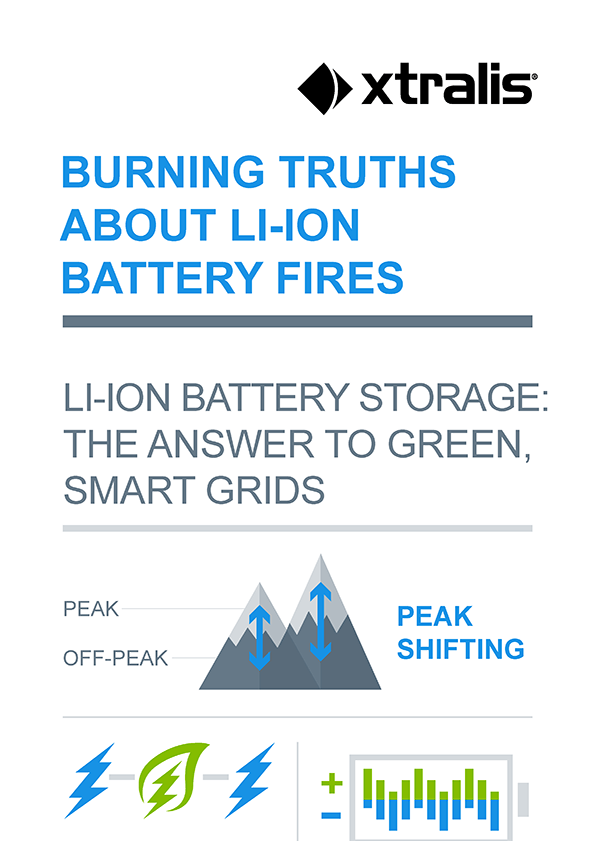
LI-ION BESS FIRE RISKS AND HOW TO OVERCOME THEM
Learn more about the risks thermal runaway poses to BESS and how to mitigate them effectively.


